

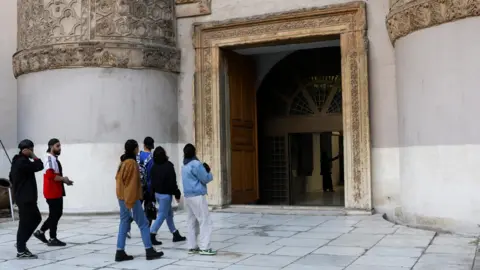
Historic sculptures and other artefacts have been stolen from the National Museum of Syria in the capital, sources confirm.
The robbery was discovered on the start of the week, when employees apparently found that one of the museum's doors had been damaged from the interior.
The multiple stolen statues were marble creations and traced back to the Roman period, one official informed the Associated Press.
Syria's Directorate-General for Antiquities and Museums said it had launched a probe to determine the "events surrounding the disappearance of a group of exhibits", and that steps had been enacted to strengthen safeguarding and monitoring systems.
The head of domestic security in the capital area, Brig-Gen Osama Atkeh, was quoted by the official media as saying that authorities were probing the incident, which he said had affected several "historical artifacts and unique items".
He added that security personnel at the museum and additional people were being interviewed.
The cultural institution, which was created in the early twentieth century, contains the most important historical artifacts in Syria.
It contains historical records originating to the ancient era from historical site, where indications of the earliest complete alphabet was found; Greco-Roman period ancient art from the ancient city, among the foremost cultural centres of the ancient world; and a third century Jewish temple that was established at Dura Europos.
The facility was had to cease operations in the early 2010s, a year after the outbreak of the internal strife. The majority of the holdings was evacuated and preserved at undisclosed sites to protect them.
It began limited operations in recent years and returned to normal in the beginning of the year, a month after opposition groups overthrew Syria's former leader.
Each of the six of nationally recognized sites were harmed or partially destroyed during the internal struggle.
The IS organization blew up multiple religious structures and other structures at Palmyra, stating that they were idolatrous. International authorities condemned the demolition as a war crime.
Many cultural items were also damaged or taken from dig sites and collections.

